
What is CPCTC?
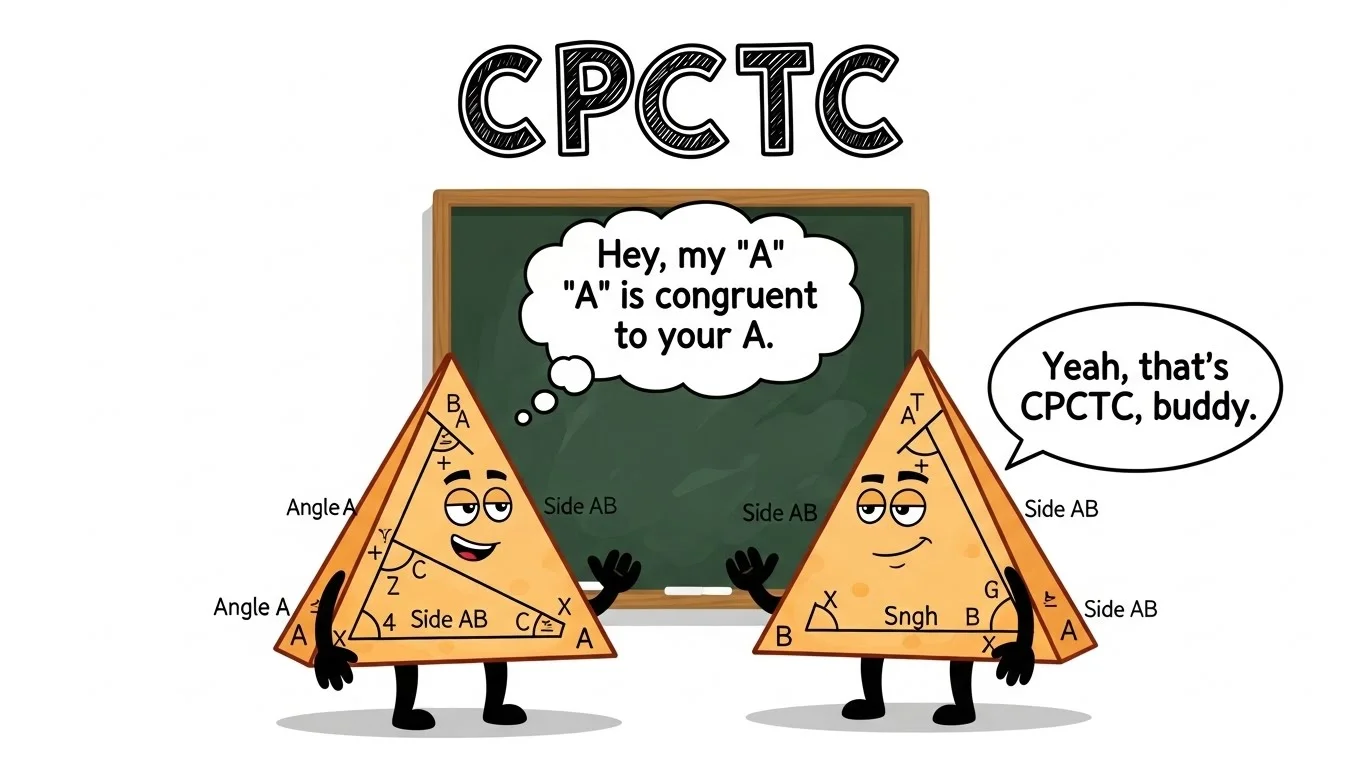
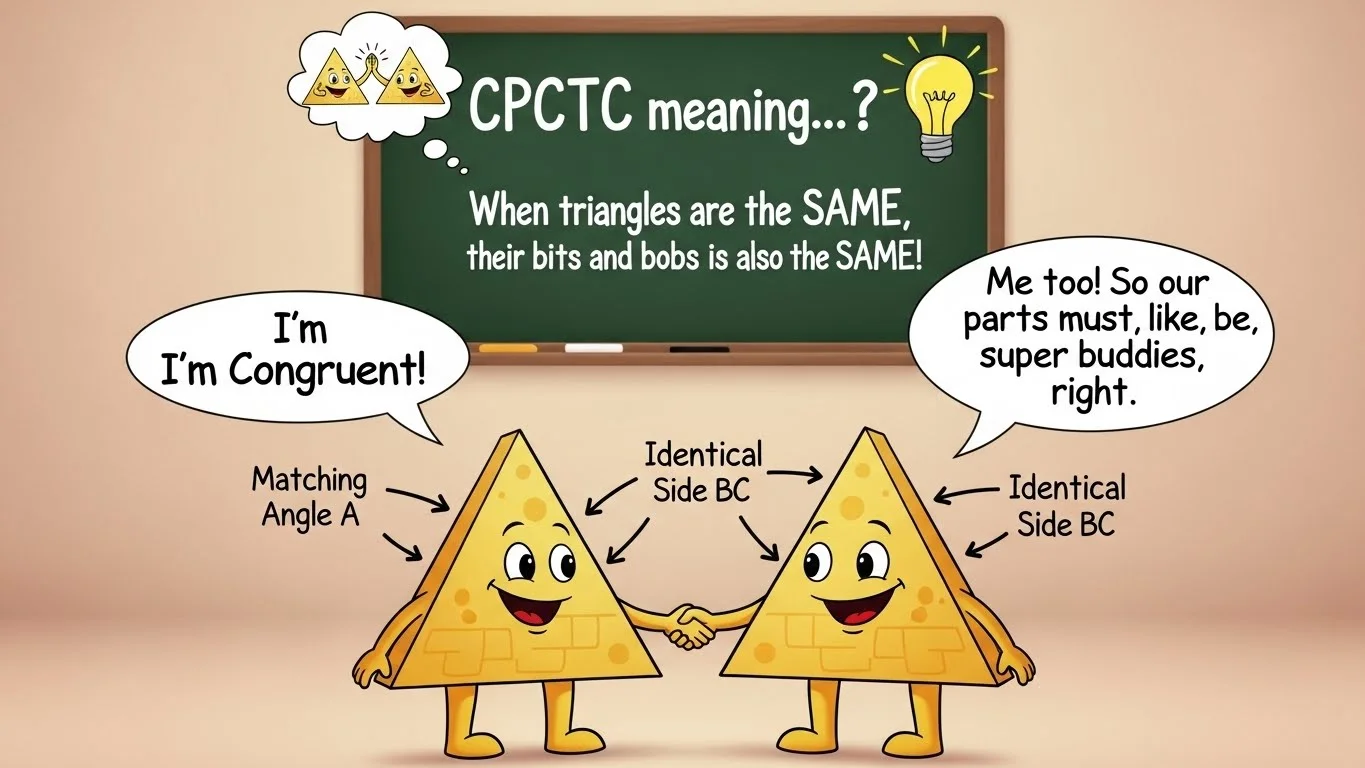
CPCTC stands for “Corresponding Parts of Congruent Triangles are Congruent.” It is a rule in geometry used to show that if two triangles are congruent, then all their corresponding sides and angles are equal.
The Full Form of CPCTC
CPCTC is an acronym:
C – Corresponding
P – Parts
C – of Congruent
T – Triangles
C – are Congruent
How CPCTC Works in Geometry
When two triangles are proven congruent using rules like SSS, SAS, ASA, AAS, or RHS, CPCTC allows you to conclude that their matching sides and angles are equal.
Example of CPCTC in Use
Suppose you have triangles ΔABC and ΔDEF. If ΔABC ≅ ΔDEF, then by CPCTC, you can say:
AB = DE
BC = EF
AC = DF
∠A = ∠D
∠B = ∠E
∠C = ∠F
Why CPCTC is Important
CPCTC is important because it lets you make claims about unknown sides or angles in congruent triangles without measuring them. It saves time in proofs and problem-solving.
CPCTC in Proofs
In geometry proofs, after showing that two triangles are congruent, you can write “by CPCTC” to justify why corresponding sides or angles are equal.
CPCTC and Congruence Rules
CPCTC can only be applied after proving triangle congruence with:
SSS (Side-Side-Side)
SAS (Side-Angle-Side)
ASA (Angle-Side-Angle)
AAS (Angle-Angle-Side)
RHS (Right Angle-Hypotenuse-Side)
CPCTC in Daily Learning
Students use CPCTC in class assignments, exams, and when solving real-world problems involving triangular shapes, like in construction or design.
CPCTC vs Similar Terms
Do not confuse CPCTC with congruence rules. Congruence rules prove triangles are equal, while CPCTC states that all corresponding parts of those triangles are equal.
Common Misunderstandings About CPCTC
Misunderstanding 1: CPCTC proves triangles are congruent. (It doesn’t; it only works after congruence is proven.)
Misunderstanding 2: CPCTC applies to all shapes. (It applies only to triangles.)
Misunderstanding 3: CPCTC can be used without congruence. (You must first prove congruence.)
CPCTC in Modern Geometry Problems
Teachers and exam papers use CPCTC to simplify solutions. For instance, in coordinate geometry, proving triangle congruence first allows using CPCTC to find unknown coordinates.
CPCTC in Real-Life Applications
CPCTC is useful in real life whenever triangular structures are involved, like:
Architecture
Engineering
Design of bridges and supports
How to Remember CPCTC
A simple way: Think “Triangles that match exactly have matching parts.” Every side and angle corresponds.
CPCTC vs Similar Acronyms
CPCTC is unique to triangle congruence. There are no other common acronyms with the same letters in geometry, so remember it is specifically tied to triangles.
Using CPCTC in Exams
In exams, after proving triangles congruent, write “by CPCTC” before stating that sides or angles are equal. This shows a clear, step-by-step logical proof.
CPCTC in Word Problems
Sometimes, problems do not mention triangles directly. Look for shapes and angles that can form congruent triangles, then apply CPCTC to solve for missing values.
CPCTC and Similar Proofs
CPCTC is part of geometric proof language. Other statements, like “vertical angles are equal” or “base angles of an isosceles triangle are equal”, often combine with CPCTC for complex proofs.
CPCTC for Beginners
If you are new to geometry, start by learning triangle congruence rules. Once you understand those, CPCTC becomes easy to use.
Why Teachers Emphasize CPCTC
Teachers highlight CPCTC because it encourages logical thinking, step-by-step problem solving, and accurate proof writing.
Visualizing CPCTC
Drawing two congruent triangles and labeling their corresponding parts helps remember which sides and angles match. Visualization makes CPCTC more intuitive.
CPCTC and Math Competitions
In competitions, CPCTC is often used to solve tricky triangle problems quickly without lengthy calculations.
CPCTC in Homework
Many high school homework exercises ask students to prove triangles congruent and then use CPCTC to find unknown sides or angles.
CPCTC in Geometry Apps and Software
Modern apps like GeoGebra or Desmos allow students to explore triangle congruence visually. Once triangles are congruent, CPCTC helps verify equal parts digitally.