
What Does Turn the Other Cheek Mean in Simple Terms
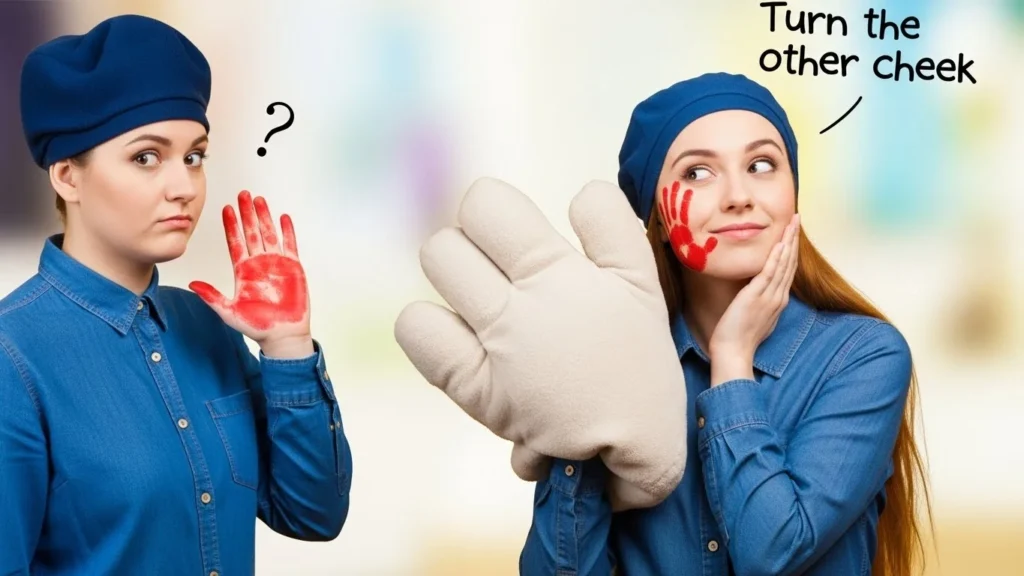
Turn the other cheek means choosing not to retaliate when someone insults, hurts, or mistreats you.
In simple words:
Do not seek revenge
Respond calmly instead of angrily
Choose peace over conflict
The Basic Definition of Turn the Other Cheek
The phrase refers to responding to wrongdoing with patience and forgiveness instead of aggression.
It encourages self-control and restraint rather than immediate reaction.
Origin of the Phrase Turn the Other Cheek
The phrase comes from the Bible, specifically the teachings of Jesus in the New Testament.
It appears in the Sermon on the Mount, where Jesus teaches nonviolence and forgiveness.
Biblical Meaning of Turn the Other Cheek
In the Bible, turning the other cheek means:
Rejecting revenge
Breaking cycles of violence
Showing moral strength through restraint
It was meant as a spiritual principle, not passive acceptance of abuse.
Historical Context of the Phrase
Historically, the phrase challenged common ideas of honor and retaliation.
In ancient times:
Insults demanded response
Revenge was socially expected
The teaching offered a radical alternative.
Turn the Other Cheek Meaning in Everyday Life
In modern life, the phrase is often used to mean:
Ignore insults
Stay calm during conflict
Choose not to escalate arguments
It is often used as advice.
Turn the Other Cheek Meaning in Arguments
During arguments, turning the other cheek may involve:
Walking away
Not responding to provocation
Keeping emotions under control
It focuses on peace rather than winning.
Does Turn the Other Cheek Mean Being Weak
A common misunderstanding is that it means weakness.
In reality, it often requires:
Emotional strength
Discipline
Confidence
Choosing not to react can be harder than reacting.
Turn the Other Cheek vs Allowing Abuse
Turning the other cheek does not mean:
Accepting ongoing harm
Staying in abusive situations
Giving up personal boundaries
It is about response, not self-neglect.
Turn the Other Cheek Meaning in Relationships
In relationships, it may mean:
Forgiving small mistakes
Letting go of minor arguments
Choosing understanding over anger
It supports long-term harmony.
Turn the Other Cheek Meaning at Work
In the workplace, the phrase can apply to:
Ignoring petty criticism
Staying professional under pressure
Avoiding unnecessary conflict
It helps maintain a respectful environment.
Turn the Other Cheek Meaning in Parenting
For parents, it can mean:
Teaching calm responses
Modeling patience
Encouraging emotional control
It promotes healthy conflict resolution.
Psychological Perspective on Turning the Other Cheek
From a psychological view, this approach can:
Reduce stress
Prevent escalation
Improve emotional regulation
However, balance is important.
Turn the Other Cheek Meaning in Modern Society
Today, the phrase is often interpreted as:
Choosing peace intentionally
Practicing emotional intelligence
Avoiding unnecessary drama
It is less about religion and more about behavior.
When Turning the Other Cheek Is Helpful
It can be helpful when:
The issue is minor
The other person seeks reaction
Conflict would cause more harm
It helps conserve emotional energy.
When Turning the Other Cheek Is Not Appropriate
It may not be appropriate when:
Safety is at risk
Abuse is ongoing
Boundaries are being violated
Action and protection are sometimes necessary.
Turn the Other Cheek Meaning in Literature and Media
In literature and media, the phrase often symbolizes:
Moral strength
Inner peace
Ethical superiority
Characters who do this are often shown as principled.
Common Misinterpretations of Turn the Other Cheek
Many people think it means:
Do nothing at all
Accept injustice
Suppress emotions
In reality, it is about choosing a response wisely.
Similar Expressions to Turn the Other Cheek
Related phrases include:
Take the high road
Let it go
Rise above it
Don’t stoop to their level
They share a similar idea.
How to Apply Turn the Other Cheek in Daily Life
You can apply it by:
Pausing before reacting
Choosing calm communication
Setting boundaries without aggression
It is a conscious choice.
Why the Phrase Is Still Used Today
The phrase remains popular because:
Conflict is universal
People seek peaceful solutions
Emotional maturity is valued
Its message remains relevant.