
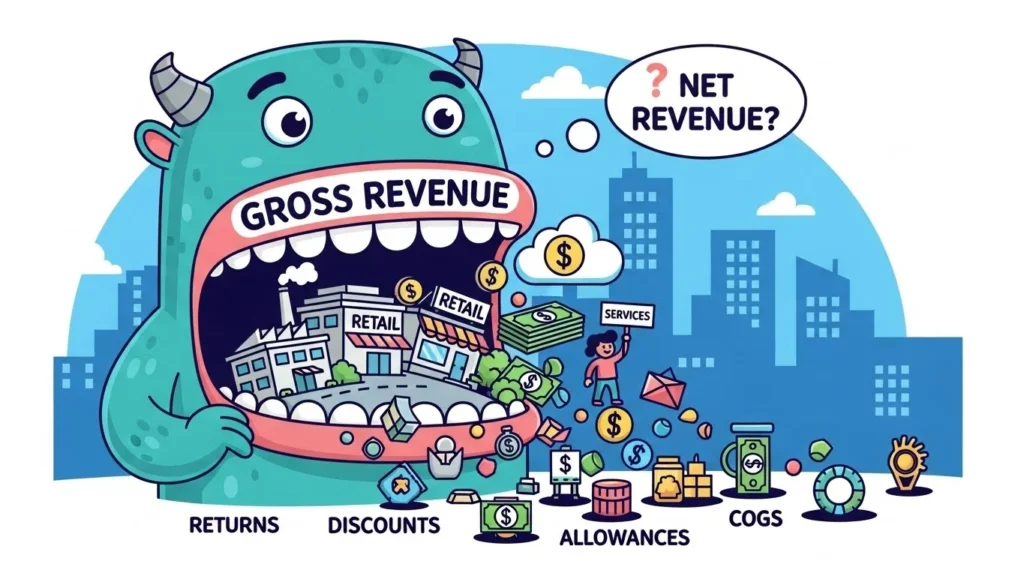

What Gross Revenue Means in Simple Terms
Gross revenue means the total amount of money a business earns from sales before subtracting any costs or expenses.
It shows how much money comes in, not how much the business keeps.
Gross Revenue Definition in Business
In business terms, gross revenue is the top-line income generated from selling products or services during a specific period.
It appears at the very top of an income statement and reflects overall sales performance.
Gross Revenue Explained with a Basic Example
If a shop sells products worth $50,000 in a month, its gross revenue is $50,000 — even if expenses are high.
Costs like rent, salaries, or taxes are not deducted at this stage.
How Gross Revenue Is Calculated
Gross revenue is calculated using a simple formula:
Gross Revenue = Total Sales × Price
It includes all money earned from customers without any deductions.
Gross Revenue vs Net Revenue
Gross revenue is often confused with net revenue.
Net revenue subtracts returns, discounts, and allowances, while gross revenue shows the full sales amount before adjustments.
Gross Revenue vs Gross Profit
Gross profit is different from gross revenue.
Gross profit subtracts the cost of goods sold (COGS), while gross revenue does not subtract any costs at all.
Gross Revenue vs Net Income
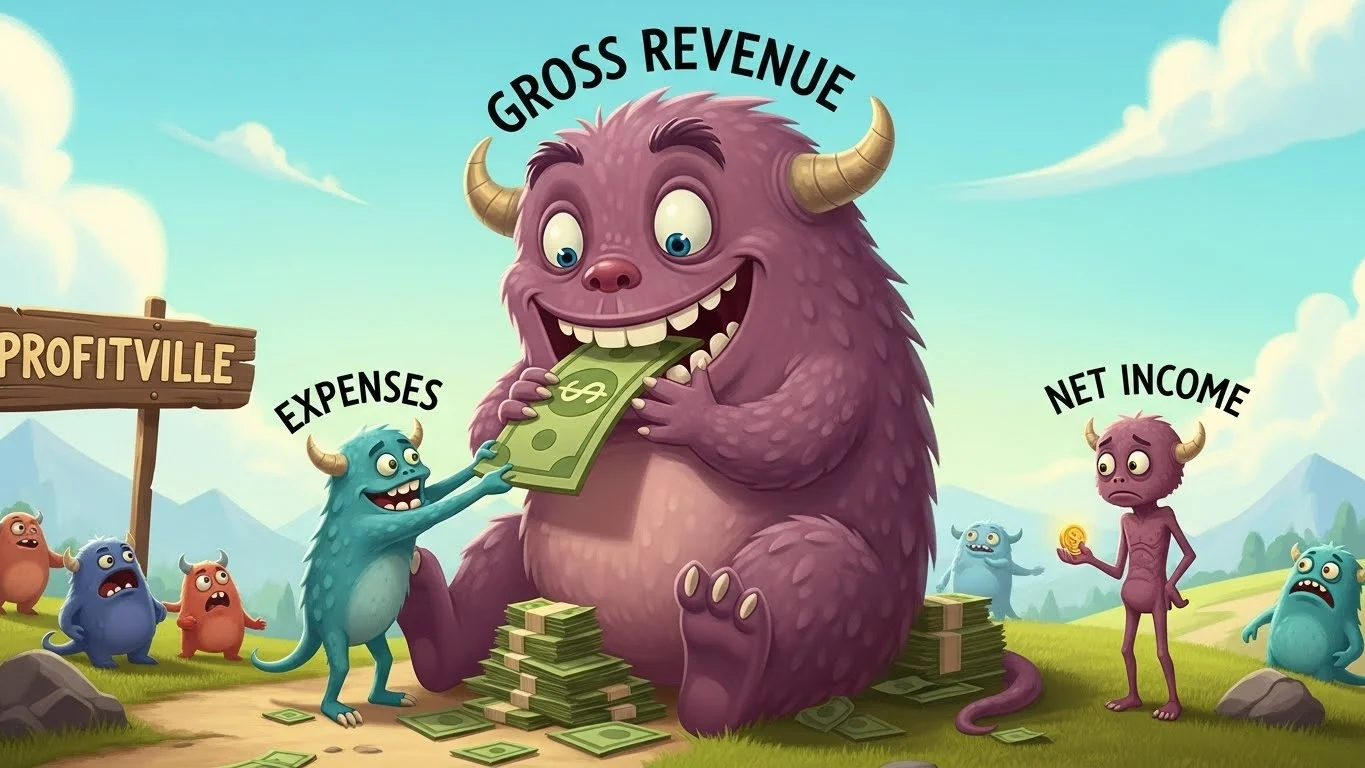
Net income is what remains after all expenses, taxes, and costs are deducted.
Gross revenue only shows total sales and does not indicate profitability.
Why Gross Revenue Is Important for Businesses
Gross revenue helps businesses measure:
Sales growth
Market demand
Customer interest
Business scale
It gives a quick snapshot of how much money is flowing into the business.
Gross Revenue in Small Businesses
For small businesses, gross revenue shows whether sales efforts are working.
However, high gross revenue does not always mean high profits if expenses are uncontrolled.
Gross Revenue in Large Companies
Large companies use gross revenue to show market size and investor appeal.
Investors often compare gross revenue growth year over year to judge performance.
Gross Revenue in Accounting and Financial Reports
Gross revenue appears on income statements and financial disclosures.
It is usually the first number listed and sets the foundation for other calculations.
Gross Revenue in Daily Life Examples
Freelancers, online sellers, and service providers also earn gross revenue.
If a freelancer earns $3,000 in a month before expenses, that amount is their gross revenue.
Gross Revenue in E-Commerce and Online Businesses
Online businesses calculate gross revenue from all completed sales.
Shipping fees, platform fees, and refunds are handled later, not in gross revenue.
Gross Revenue and Taxes Explained
In many countries, taxes are based on net income, not gross revenue.
However, some reporting requirements still ask for gross revenue figures.
Common Misunderstandings About Gross Revenue
Many people believe gross revenue equals profit.
This is incorrect because gross revenue ignores expenses, costs, and deductions.
When Gross Revenue Can Be Misleading
A business may have high gross revenue but still lose money.
This happens when operating costs are higher than earnings.
How Gross Revenue Is Used by Investors
Investors use gross revenue to assess:
Business growth
Market demand
Revenue trends
It helps them compare companies in the same industry.
Gross Revenue in Startups and New Businesses
Startups often focus on gross revenue growth to prove traction.
Early-stage businesses may have losses even with rising gross revenue.
Gross Revenue vs Turnover
In many regions, turnover and gross revenue mean the same thing.
Both refer to total sales before deductions.
Gross Revenue in Modern Business Reporting (2025)
In 2025, gross revenue remains a key performance metric.
Digital businesses, subscription models, and online platforms all rely on gross revenue tracking.
How to Improve Gross Revenue
Businesses increase gross revenue by:
Selling more products
Raising prices carefully
Expanding customer reach
Improving marketing strategies